MIRRORLESS VS. DSLR: WHAT'S THE REAL DIFFERENCE?
Mirrorless cameras offer newer technology and modern conveniences, while DSLRs remain incredibly capable tools. Beautiful photographs have been—and continue to be—made with both. So what's the difference? Let's take a closer look.
1. The Mirror
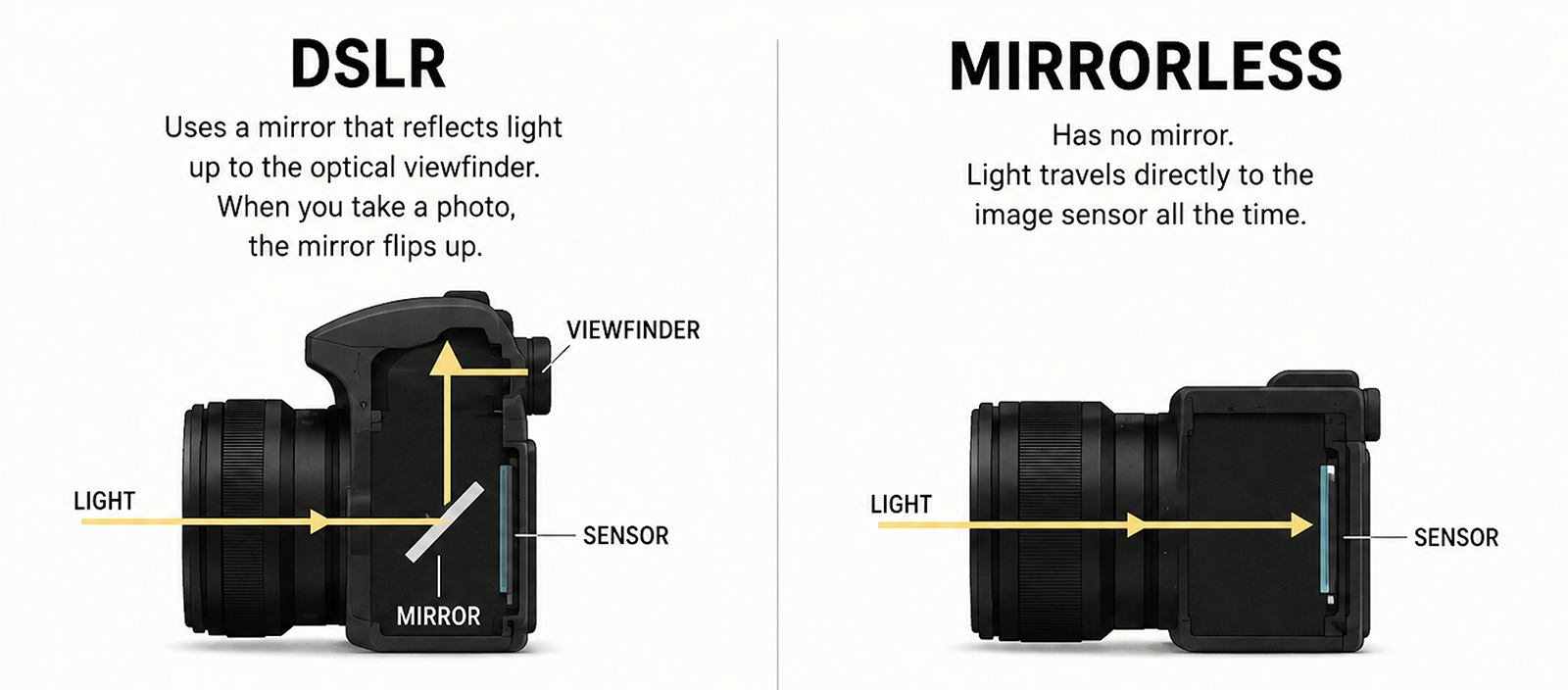
DSLR: Uses a mirror that reflects light up into an optical viewfinder. When you take a photo, the mirror flips up.
Mirrorless: Has no mirror. Light travels directly to the image sensor all the time.
A simple way to say it:
The biggest difference is in the name: a mirrorless camera simply removes the mirror found inside a DSLR.
Make it stand out
The biggest difference is in the name:
A mirrorless camera simply removes the mirror found inside a DSLR.
2. What You See in the Viewfinder
DSLR
Optical viewfinder.
You’re looking through the actual lens using reflected light.
No electronic display.
Mirrorless
Electronic viewfinder (EVF).
You’re seeing a tiny live video feed from the sensor.
This means you can preview:
Exposure
White balance
Picture style
Depth of field (on many cameras)
before pressing the shutter.
3. Size and Weight
Mirrorless cameras are often:
Smaller
Lighter
Easier to travel with
4. Autofocus
Modern mirrorless cameras generally have the advantage.
Many offer:
Eye detection
Face detection
Animal autofocus
Subject tracking across almost the entire frame
Older DSLRs often focus through a smaller cluster of autofocus points near the center.
5. Silent Shooting
Most mirrorless cameras can shoot silently using an electronic shutter.
This is useful for:
Weddings
Theater
Museums
Wildlife
Street photography
DSLRs always make the familiar mirror slap unless they have a special silent mode, which is usually quieter but not completely silent.
6. Battery Life
DSLRs generally last longer on a single battery because the optical viewfinder doesn’t require power.
Mirrorless cameras power the sensor and electronic viewfinder continuously, so they typically use batteries faster.
7. Seeing the Exposure Before You Shoot
One of the biggest practical advantages of mirrorless:
If your image is too dark or too bright, you’ll usually see it immediately in the viewfinder before taking the picture.
With a DSLR, you often don’t know until you review the image afterward.
8. Video
Mirrorless cameras have become the preferred choice for many videographers because they typically offer:
Better autofocus while filming
Advanced video features
Easier monitoring through the electronic viewfinder and rear screen
9. Image Quality
This surprises many people:
A mirrorless camera does not automatically produce better image quality.
Image quality depends primarily on:
The sensor
The lens
The photographer
A DSLR and mirrorless camera with similar sensors can produce virtually identical images.
Is One Better? The best camera is the one that helps you stay present with your subject. Whether you shoot with a DSLR or a mirrorless camera, the photograph is ultimately shaped by your eye, your light, and your connection to the person in front of the lens.
As always, best of luck!
Reach out! Drop a line and share what type of content you'd like to see on this blog.
All images distributed by Leticia Valdez Fotografia are professionally copyrighted works. These images cannot be used or altered for any purpose without permission. Copyright © 2026 Leticia Valdez Fotografia LLC.